
Credit cards are strange things.
They are probably the most convenient way to pay for anything in India today. They come with rewards, interest-free days, lounge access and a decent shield when a merchant misbehaves. Most of us on the Fold team use them every day.
They are also, quite deliberately, built to make spending feel like nothing happened. You tap, the terminal beeps, and you walk away. Your bank balance does not move. The money only "leaves" weeks later, in one lump, on a statement most people open once, look at the total, and close.
Behavioural economists have a name for the feeling that is missing here: the pain of paying. When you hand over cash, or watch your balance drop, a small part of your brain registers the loss. That little sting is useful. It is what makes you pause before the second coffee or the third food order of the week. Cards are excellent at removing it.
We did not want to build a feature that tells people to stop using credit cards. We wanted to bring the sting back, without giving up the convenience. This post is about how credit card tracking on Fold tries to do that, and what we learnt building it.
Every transaction, the moment it happens
Credit cards are not on India's Account Aggregator network yet, so Fold cannot fetch card data the way it fetches your bank accounts. What every card issuer does send, though, is an email: one for every transaction and one for every statement.
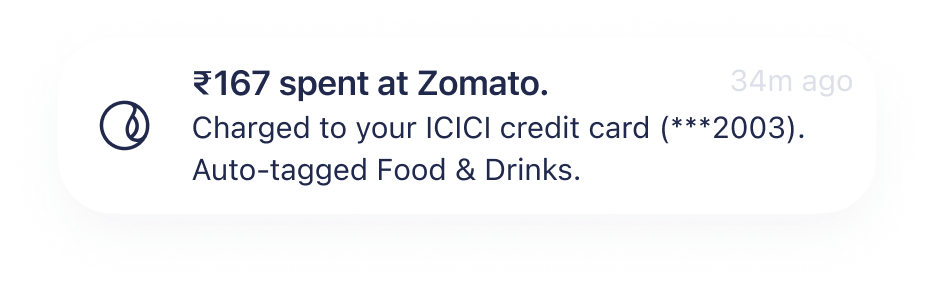
So that is what Fold reads. You connect the Gmail inbox your card alerts go to, and Fold picks up only the alerts and statements sent by your bank. Nothing else in your inbox is touched. Because these emails arrive within seconds of a swipe, so does the transaction in Fold. It shows up categorised, with the merchant cleaned up, a few seconds after you pay, whether that was a tap at a store or a RuPay credit card on UPI.
The notification is the part people tell us about most. You pay, and before you have put your phone back in your pocket, Fold tells you what you spent and where. It sounds small. In practice it is the closest thing to watching notes leave your wallet. And sometimes the notification is for a transaction you did not make, which is exactly when you want to know right away rather than at the end of the month.
Statements, dues and paying the bill
When your statement lands, Fold reads it too, and lets you know it has arrived. You see the statement amount, the due date, your limit and how much of it you have used, without opening the issuer's app. When it is time to pay, you can pay the bill right inside Fold over UPI, through NPCI's Bharat Connect. There is no fee for paying, and the payment is linked back to the card automatically so it does not show up as spending twice.
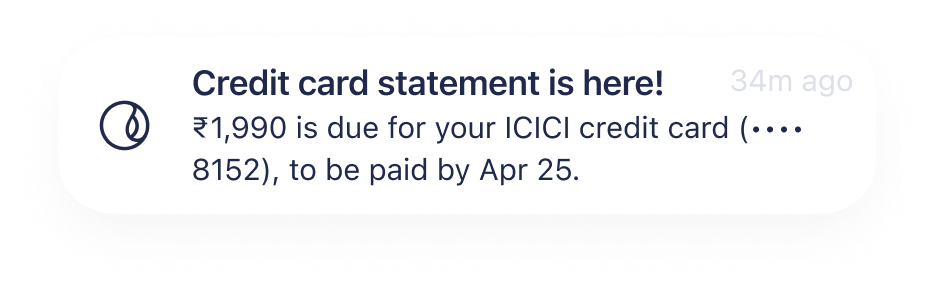
If you have several cards, this is where the time savings add up. Five cards means five due dates, five apps and five statement passwords. On Fold, it is one list.
The balance you actually have
There is one feature a lot of people quietly end up relying on, and it is the one we are proudest of. We call it augmented balance.
Your bank balance is a lie, in a small and specific way. If your account says ₹80,000 and you have ₹22,000 sitting on your cards, the money you can actually spend is ₹58,000. The other ₹22,000 is already gone, you just have not paid for it yet.
Turn on augmented balance and Fold shows you that second number. It subtracts what you owe on your cards from what is in your bank accounts, on the home screen and in the balance widget, so the number you glance at is the number that matters. You can also choose to include recurring dues, like rent or an EMI that is about to go out.
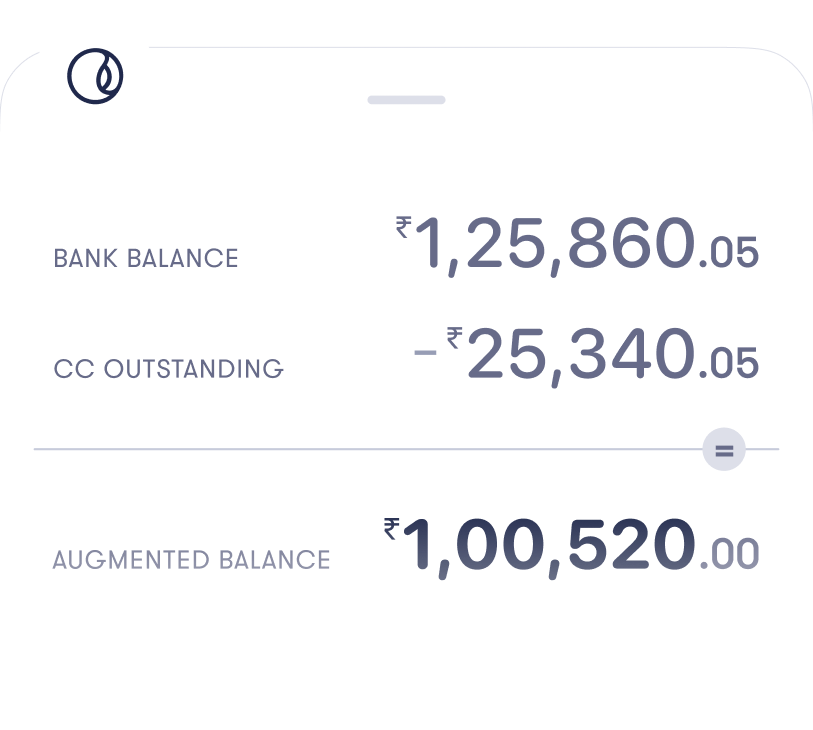
It is a subtle shift. But people tell us it changes decisions: the weekend trip gets planned against the real number, the big purchase waits for the bill to clear. Several of us on the team now put more on our cards than before, not less, because the money no longer disappears silently.
Fast, private, and a bit nerdy
A few things about how this works under the hood, because people ask:
Fold reads only the card alert and statement emails from your bank. It does not read, store or look at the rest of your mail. You can disconnect the inbox at any time from the app.
Parsing happens on known issuer formats. We support 23 card issuers today, including HDFC, ICICI, Axis, SBI Card, Kotak, IDFC FIRST, IndusInd, HSBC, RBL, AU, Scapia, OneCard and more, and we add formats as issuers change them.
Transactions from your cards and your bank accounts land in the same timeline. They count towards the same cash flow and the same spending summary, so your card spends are not stuck in a separate silo.
What is next
When we first wrote about real-time card tracking, two requests came up again and again: more than one inbox, and add-on cards. Many people have cards scattered across a personal and a work email, and many households share a card limit across a primary and an add-on card. We are working on both.
Credit cards do not have to be something you deal with once a month, when the bill arrives. They can be something you understand as you use them. That is what we are building towards.
If you have a credit card and have not connected it to Fold yet, give it a try in the app. If you get stuck anywhere, write to us at [email protected] and we will help you out.
Update, October 2026: multiple Gmail accounts are now live on Fold Plus (up to five inboxes), along with a dedicated Cards tab that shows your total outstanding, upcoming dues and credit score in one place. Lite includes one inbox and up to five cards; Plus includes up to 30 cards and American Express.